
Socially-distanced Santa: one Miami development has modified it’s annual holiday pop-up.
FRANCISCO AGUILA
With more people staying home for the holidays, some high-end residential developments are going all out on their holiday amenities, while making sure they’re safe and socially distanced.
In New York City, for example, the luxury condo 50 West, in partnership with a company called Axiom Amenities, is creating its own Elf on the Shelf scavenger hunt, providing winter holiday boxes with hot chocolate kits, holding a building-wide sugar cookie decorating contest and socially-distanced Sufganiyot event and holding a building-wide Secret Santa.
At nearby luxury rental 525 West 52nd Street, residents can take part in a grab-and-go holiday happy hour, complete with cheese and charcuterie and dessert in mason jars.
In Miami, the Reach and Rise Residences at Brickell City Centre is still hosting its annual “Santa’s Post Office” pop-up through December 24. Residents of the mixed-use development recently had a day to exclusively take pictures with Santa at a COVID-19-mandated 8 feet away.
Christa Dabkowski, vice president of marketing for Swire Properties, the developers behind Brickell City Centre’s Reach and Rise residential towers, said the property has changed its traditional holiday celebrations to focus on its local residents.
“Specifically, with COVID-19 impacting international tourism – which typically is a huge traffic and sales driver in this region, particularly taking into account that so many Latin American families make their homes here for good parts of the year, particularly winter – we really needed to rethink our holiday programming,” Dabkowski says. “Our focus is our foundational audience – those who live and work in Brickell. As a mixed-use lifestyle centre, our residents – who literally live atop the retail – are our family and want, more than ever, for their home to be everything they need. As such, we’ve instituted things like private nights with Santa, with one family at a time, in our innovative, socially-distant Santa’s Post Office experience, as well as ways to support local small businesses with our rotating ‘Holiday Pop-Ins.’ In short, no one has to go far to get a little holiday magic.”
Residents of Drewery Place in Houston will have a social event as last year, but the developers are making it an outdoor street party.
“We had a Christmas celebration last year for the residents, it’s great for them to meet their neighbors,” says Emma Alexander, acting chief operating officer and director of sales and marketing for Drewery Place developer Caydon. “Celebrating this year is even more important we believe because it’s been such a tough, tumultuous year for so many due to COVID. It’s nice to have something to look forward to, even if you do have to social distance.”
The Original Article Published On The Forbes
When 8.5 million people live in 300 square miles, outdoor space to relax and breathe fresh air can be hard to find. To help fix this problem, more New York City property owners, who typically look upward for expansion opportunities, are converting residential rooftops into luxurious courtyards, experts said.
Their value is proved by numbers, noted Citi Habitats broker Josh Sarnell: A roof deck can add $150 to $300 to a base rent or $50,000 to $100,000 to a sales deal, he said.
The open-air amenities offer the immediacy that New Yorkers, who have their groceries delivered and Uber to the movies, famously crave. They can feature everything from swimming pools to vegetable gardens and barbecue areas, but perhaps their most popular features are the parties and other gatherings buildings host on them, Sarnell added.
He has represented numerous properties with access to verandas in the sky. Instead of trekking to parks or meeting friends at bars, “a lot of younger people like to have events planned for them,” he explained. “It’s a shift from staying in your apartment to community living.”
In the spirit of summer, here’s a look at some of the most lavish roof decks built into the New York City skyline:
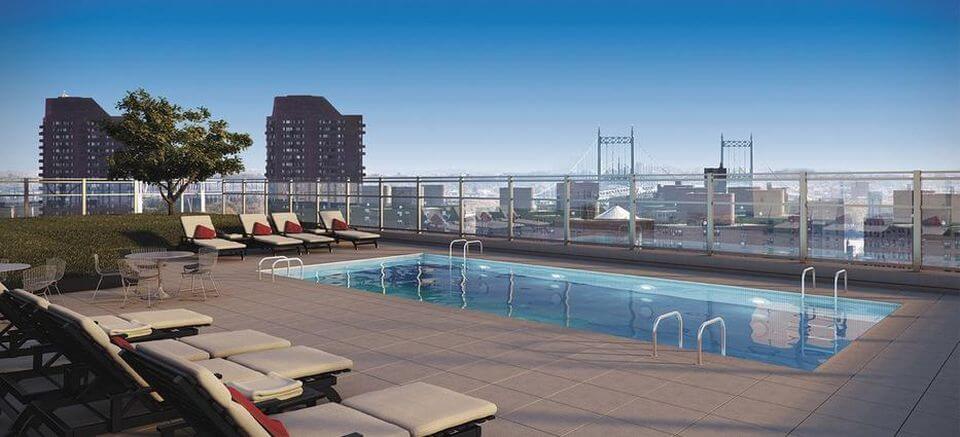
“There’s something beautiful about being on a New York City roof in a pool,” One Museum Mile resident Kim Soderstrom said dreamily. She lives in a two-bed, two-and-a-half-bath in the Carnegie Hill condo with her husband and their pet rabbit. The building’s heated 20-by-40-foot lagoon, which sits 21 stories into the sky, is an oasis for residents.
“We don’t have any tall buildings south of us and so when you’re in the swimming pool floating on your back you just see the sky and it’s amazing,” said Soderstrom, a children’s book writer who’s loved to swim since childhood. Her building’s 1,570-square-foot roof deck provides full views of Central Park and the city’s bridges, an outdoor kitchen and grills, and showers and lockers.
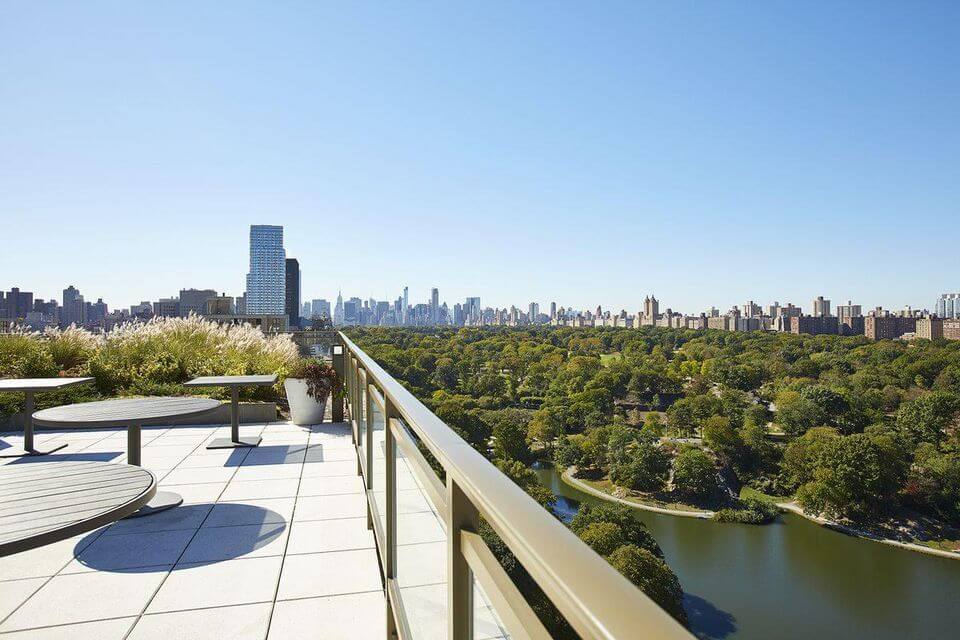
Soderstrom’s husband is an attorney and works long hours, so the couple is happy to avoid spending time in traffic to get to the beach. “We feel like we’ve gotten away for the weekend and all we had to do was go to the roof,” she said. “It’s an elevator ride away and it’s a completely different world.”
525 W. 52nd St.
Average rent price: $4,655 (StreetEasy)
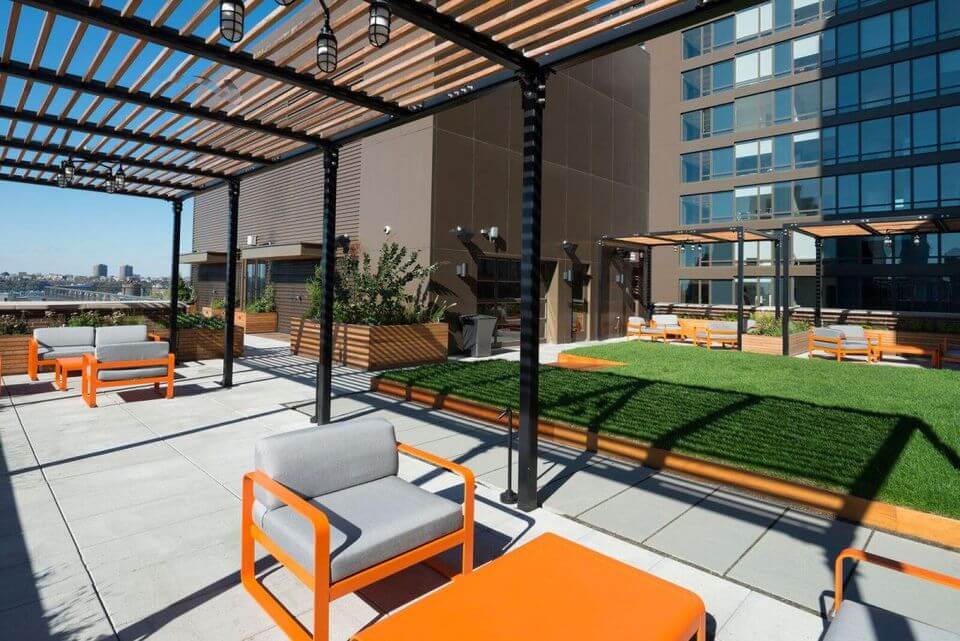
Above the 16th floor at 525 W. 52nd St., residents can picnic on real grass or head through a garage door-style entrance to a private party room where luxury service brand LIVunLtd hosts events like wine tastings and barbecues. Resident Kyle Wilkinson and his wife, whose firm designed the 3,000-square-foot roof deck’s plantings, moved into a one-bed, one-bath rental in November 2017 and their daughter followed them into the building this spring. Though she and other younger tenants like to lounge on cabana chairs in the unblocked sunlight, Wilkinson said he prefers the shaded areas, where he works as a data science consultant or takes time to think.

“Every once in a while I just go up there and actually just sit and look at the river,” Wilkinson said. “[A roof deck] is a dimension adding to your well-being and happiness,” he added. “You know you can go up there and that means a lot.”
555 Tenth Ave.
Average rent price: $5,332 (StreetEasy)
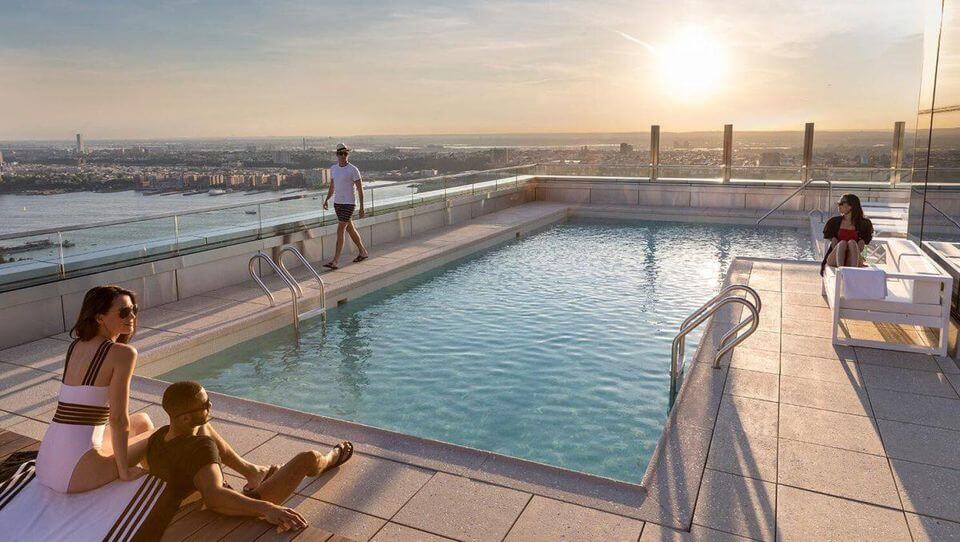
To cool off on warm days, tenants in 555TEN can take a dip in a 15-by-43-foot saltwater plunge pool 56 stories above the city street. The Hell’s Kitchen building’s 7,151-square-foot roof also has an all-seasons clubhouse and chaise lounges, along with private cabanas. The deck provides a reprieve from the busy city, resident Andrew Ackerman said. “New York is hectic and there’s lots of cars and buses and honking and people, and we’re not that close to Central Park,” resident Andrew Ackerman said. “A roof deck is your own little relaxation area where you can lie in the sun, read a book and just get away from all the hectic pushing and shoving and noise [in the city].”
The building’s 7,151-square-foot roof also has an all-seasons clubhouse.Ackerman, who is enjoying his retirement in a 500-square-foot loft in the rental building, added that he enjoys the roof year-round since the pool is heated and the event space has a fireplace for winter.
510-524 E. 14th St.
Starting rent price: $7,500
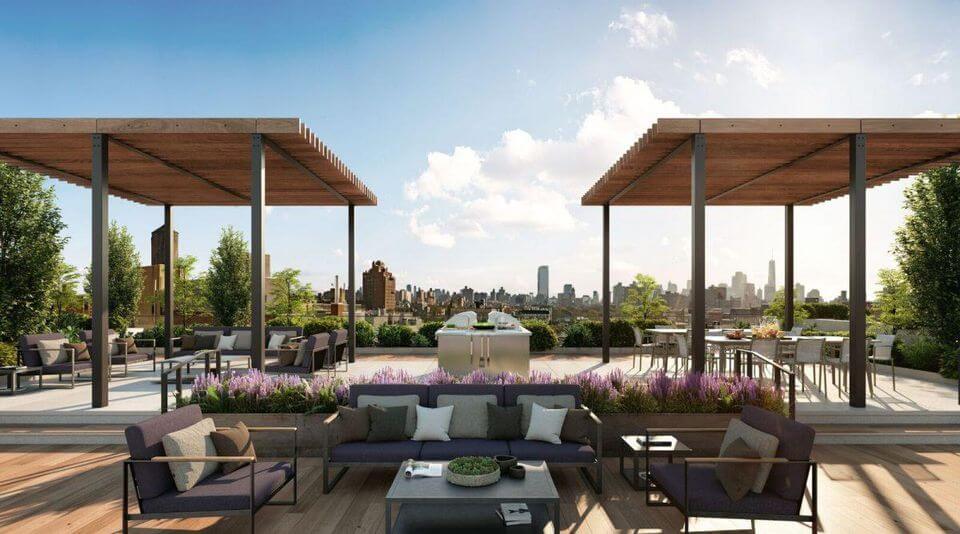
Spanning 19,000 square feet, the seventh-story deck atop Extell Development‘s new EVGB (short for the East Village’s Greatest Building) “just doesn’t feel overcrowded,” said Dr. Jamie Royal. And if that isn’t enough outdoor space, its second-floor terrace is divided by fencing to give its units a private garden, so Royal’s two-bed, two-bath rental has a backyard. The rooftop amenity, meanwhile, features grills and fire pits, a bocce court and putting green, a screening area, garden plots and an outdoor shower.
Though Royal currently spends time up there with her husband and two kids, she intends to use it to entertain colleagues who give referrals to her orthodontist practice. “The views are insane and if I can bring a couple doctors up there and have drinks one night it’s a cool, different thing to do,” she said.
30-02 39th Ave., Queens
Average rent price: $3,000 (StreetEasy)

Across the river in Long Island City, ARC’s 70-foot saltwater pool, bocce courts and grilling areas are “the perfect trifecta of stuff,” said resident Andrew Haynes. He recalled a work-from-home day when he used the roof as his office space. “Being able to sit by the pool and check some emails and jump in to cool off, it kind of felt like I was in Miami,” he said.
The development takes outdoor space seriously – residents also have access to a half-acre courtyard and a greenhouse for gardening. The eleventh-story rooftop, meanwhile, provides unblocked views of Manhattan thanks to its location in western Queens. Haynes, who lives in a one-bed, one-bath rental with his wife and their dog, added that being in an outer-borough is kind to their budget too: “Having those things and not having it cost an arm and a leg is awesome.”
Update: This article originally included a deck in the Gateway complex in Battery Park City, which is on the fourth floor of the building.
The original Article published on The New York Post
City living is a blast, no doubt, but in a metropolis of 8 million, having fun can sometimes be a grind. Want to grab a cocktail? Buy some vegetables? Get a blowout?
Sounds great, but you better be ready to fight it out in line with the rest of the animals.
Unless, of course, you live in a place where you can go out while staying in.
From a bar to an on-site farm to a hair salon, new real estate developments across the five boroughs (and in Jersey, too) are amping up their amenities to include experiences that once required a trek outside. And, because nothing makes a nice thing nicer than a whiff of exclusivity, many of these perks are strictly residents-only.
Take, for instance, 571-unit Staten Island Urby (rents from $1,890 to $2,900), which offers “farm-to-apartment” dining. The development near the ferry stop in St. George has a 5,000-square-foot farm along with an apiary run by husband-and-wife team Asher Landes and Zaro Bates. He keeps the bees, she handles the farm.
The building’s harvest isn’t exclusive to residents — the couple sells to local chefs and through a CSA — but renters can request particular foods for planting, Landes says. Just try that at your local Gristedes.
About half of the CSA’s 45 members are building residents. Among the crops offered are salad greens, root vegetables, tomatoes and squash, Bates says. Full shares cost $22.50 a week ($450 for the season) and half shares are $12.50 ($250 for the season).
Then there’s Rockpoint Group and Brooksville Company’s 807-unit 63 Wall St. (rents from $2,635 to $6,686), where management has converted offices in the former headquarters of bank Brown Brothers Harriman & Company to an on-site bar dubbed a “speakeasy.”
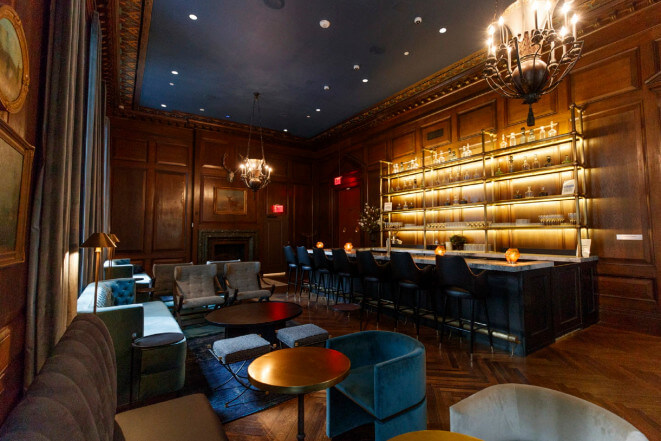
Decked out in grand Roaring ’20s style with wood paneling, chandeliers and a custom brass-and-marble bar, the spot, which officially opens next month, is ideal for unwinding with an adult beverage and some light snacks. But to knock one back, you’ll need to live in the Financial District building — or at least know someone who does.
The bar, serving beer from $5 and cocktails from $12, is open to 63 Wall residents and their guests only.
“It’s like a private club,” says David Sorise, a senior vice president with Pinnacle City Living, which manages the building. “People are really interested in having a place that’s private, where they can gather with their friends and other residents in a kind of closed environment.”
Across the Hudson, tenants of KRE Group’s Jersey City rental building Journal Squared (from $2,149 to $3,551) are treated to similarly exclusive entertainment. The building has partnered with the company Basecamp, which arranges lodging for traveling musical acts. In exchange for playing free shows for residents (and up to four guests), bands get to crash, gratis, in a Journal Squared apartment during the NYC leg of their tours.

Since the program started in December of last year, Journal Squared has hosted six concerts by acts including Mikky Ekko (featured on Rihanna’s 2013 single “Stay”) and Anthony Russo (whose song “California” generated some buzz last year). The shows typically draw crowds of 150 to 200 people, says Amanda Vittitoe, director of marketing at KRE. Not bad for a 538-unit building.
The shows also give residents a chance to dip their toes in the rock ‘n’ roll lifestyle.
“You get to hang out with the band, see them perform, and then they kind of chill out [with residents] afterwards,” Vittitoe adds. “You can be like a groupie.”
Sounds like more fun than an in-building business center.
At 445-414 Gerard Ave. in the Mott Haven section of the Bronx, Treetop Management is building a 416-unit rental complex (monthly prices not yet available) that will include a professional-grade audio and video production space as well as a podcast studio — all intended to target a younger, creative demographic, says Bond New York’s Douglas Wagner, who represents the development.

Do these out-of-the-box features truly lure tenants and buyers? Probably not, says Andrew Witzke, 28, a renter at Taconic Investment Partners’ 392-unit building 525 W. 52nd St. That said, they’re certainly fun. He and his fiancée Shaylyn Harper, 27, are big fans of the development’s various experiential amenities, which have included private tours of the Hudson Valley’s Storm King Art Center and Benmarl Winery.
The couple moved to Manhattan last year from Boston, and found the outings “a very easy way to make friends and meet people and start to recognize faces around the building,” says Witzke, who works in management consulting. “It wasn’t material to our decision [to rent at 525 W. 52nd St.], but it’s a really nice benefit we’ve gotten a lot of value out of.”
A self-professed golf nut, Witzke adds he particularly likes the golf simulator, which has hosted lessons from pros. A $75-a-month fee covers building events as well as access to common areas like the rooftop lounge (the website lists availabilities from $3,909).

Another really nice benefit: Having a James Beard Award-winner whip up a menu for your dinner party. Owners at Extell Development’s 92-unit Hudson Square condop (a building that consists, typically for tax purposes, of a condo subdivided into cooperative shares) 70 Charlton St. enjoy exclusive access to celebrity chef Charlie Palmer for services like menu planning and wine collection curation (prices depend on the size of the job). Residents also get bonuses like VIP reservations and kitchen tours at Palmer’s restaurants around the country.
Among the buyers at 70 Charlton is farm-to-table evangelist Palmer himself, so neighbors might also hobnob with the chief informally. “These are the type of people who are going to Charlie’s restaurants, who want that experience of going back to the kitchen for a tour and want to go to different curated dinners,” says Elysa Goldman, vice president of development at Extell.
More mundane perks also benefit from the glow of exclusivity. Sure, a person can go shopping at BCBG anytime they want (online even!), but that’s clearly not as much fun as getting the run of the place on your own, as recently happened for renters at real estate firm Instrata’s Nomad and Gramercy developments. The brand’s 168 Fifth Ave. location was open for two hours exclusively to residents of the two buildings, who could take advantage of a little extra elbow room as well as special discounts, says Neeta Mulgaokar, a broker with Mirador Real Estate who helped set up the event. (There was no cost for admission.)
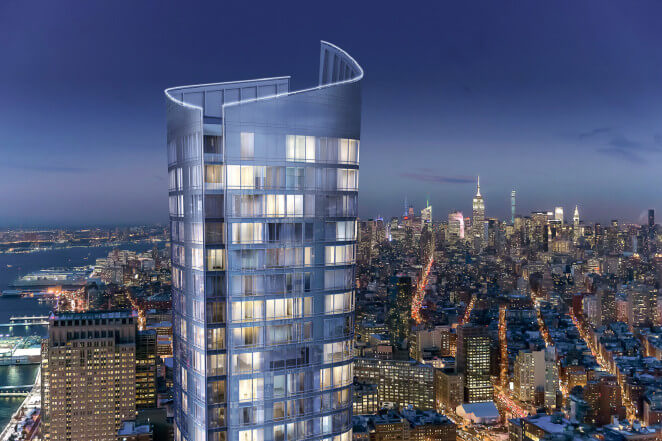
Meanwhile, 111 Murray St., the 157-unit Tribeca condo tower from developers Fisher Brothers, Witkoff and New Valley (prices from $4.3 million to $40 million), will have a residents-only Drybar salon, where services will cost the same as the chain’s other locations (from $45 in New York).
“When you go to these kinds of places, you have to deal with a lot of crowds of people. You have to deal with waiting times. There’s not a ton of privacy. And it’s definitely not as convenient,” says Lauren Witkoff, executive vice president at Witkoff. “This takes a luxury that [residents] would normally have to go outside their home for and gives them the convenience and privacy of having it right in the building.”
For that price, they deserve it.
The Original Article Published On The New York Times
By Joyce Cohen
A year ago, when Frederik Fredsted Christiansen was sent from his native Copenhagen to New York for work, his company set him up above one of its stores.
Mr. Christiansen, 29, is president of United States operations for Joe & The Juice, a Danish chain serving coffee, smoothies and sandwiches, and he oversees the company’s 23 retail stores here, 13 of them — soon to be 16 — in New York.
His tiny studio on Prince Street had two windows and was hot in the summer and cold in the winter. Also, “there was a wall two meters from the window,” he said, “so there was no sunlight.”

In Copenhagen, “we have big apartments for reasonable money, and we have windows where sunlight is coming in,” said Mr. Christiansen, who at one point managed his company’s largest store, at Copenhagen Airport. “It was really weird for me,” he added, that “I never saw the sun.”
He was surprised, too, by how old-fashioned some things were in New York. To pay his rent, for example, he had to write a check, whereas in Denmark, he said, “you pay everything on the internet or transfer via your bank on your mobile app.”
For six months, the company paid Mr. Christiansen’s monthly rent of $2,300. Once he assumed the payments, he became increasingly eager to move.

With a budget of about $3,000 a month — and sunlight his primary requirement — he began looking for an apartment somewhere around Midtown. In early summer, using StreetEasy, he found a newly renovated one-bedroom with a private roof deck in Hell’s Kitchen, for $3,000 a month. He was ready to sign on.
Then the agent asked if he had credit.
Mr. Christiansen didn’t know what that was. “It hit me that this is going to be harder than I thought,” he said. He had a debit card, but as a newcomer, no credit history in the United States.
“It doesn’t matter how much money you have in your account,” he said. “If you don’t have credit, you can’t get the apartment.”

Still, he told himself, “it’s impossible it’s like that everywhere,” and continued his search.
He soon found a large studio with an even larger terrace in a 2009 boutique condo building in Midtown. The terrace, however, was in the shadow of surrounding buildings. And because of the placement of the apartment’s doors, windows and kitchen, there was little wall space. A narrow hallway, described as a dressing area, seemed useless.
It was easy to pass on the apartment, which was $2,500 a month.
Next, Mr. Christiansen found the website for a new building in Hell’s Kitchen, 525 West 52nd Street. He informed the leasing associate, Andrés Pellot-Ramos, of his desire for natural light, and Mr. Pellot-Ramos showed him three studios. The view from the first two, on lower floors, was partly blocked, but the third unit was higher up.
“He planned it,” Mr. Christiansen said. “Suddenly, I could see the whole city, and I knew right away.”

He also knew that in a brand-new building he wouldn’t have to worry about the heat, the cold or anything else.
“I said, ‘I am going to take this,’” Mr. Christiansen recalled. “And Andrés said, ‘Do you have credit?’”
Since he did not, the building connected him with TheGuarantors, a service that guarantees leases for renters who don’t meet rental requirements, like having a United States credit history or an annual income that meets the building’s requirement (in this building, 40 times the monthly rent). The company has a sliding fee scale, but typically charges around 80 percent of a month’s rent.

“I really wanted this apartment and was scared it would slip through my fingers,” Mr. Christiansen said. He was relieved to be approved quickly by TheGuarantors.
Mr. Christiansen’s rent is now $3,390 a month, and he received three months free on a two-year lease. (The building is currently offering two months free on a 14-month lease.)
He arrived in the summer, bought new furniture and adopted a dog, Vera. “I am going to stay here for a long time, and it is time to make it feel like a home,” he said. He has plenty of closet space and a stacked washer-dryer.
During his first few weeks, he said, he was awakened by heavy construction at 7 a.m., but now it is not as early or as loud, though work continues on the building’s interior.
Cellphone reception is spotty, he said, but apart from that, “everything works” in the building. And he doesn’t have to write a rent check — tenants have the option of paying online with ClickPay.
One building amenity, a screening room, was especially welcome. “I take my computer to the cinema screen and watch my little brother play on Danish television,” said Mr. Christiansen, whose brother is a professional soccer player. “It is like being in the stadium myself.”
He is used to luxuries like that in hotels, he said, “but not in buildings where normal people live.”
Best of all, he keeps his blinds open at night and awakens to the sunrise. “It’s nice to walk around an apartment where you don’t have to have your lamps on all the time,” he said. “It makes you happier.”
Original Article Published On The New York Times
By Ronda Kaysen
For many New Yorkers, the best kind of neighbor is a quiet one who offers little more than a cursory nod in the elevator. Yet, when Gotham West, a luxury apartment building in Hell’s Kitchen, announced an October outing to an apple orchard, nearly 50 people signed up in 15 minutes, filling the charter bus, and leaving another 15 names on a waiting list.
Why did so many people jump at the opportunity to spend an entire day with their neighbors at a farm in Warwick, N.Y., a small town about an hour and a half north of Manhattan?
Maybe New Yorkers actually want to bond with the people down the hall, at least that’s what Gotham West management seems to think. Residents who sign up for the building’s $700-a-year amenity package have access to an endless social calendar with events like movie nights, mixology classes, cider tastings and a Halloween costume party.
The trip to Pennings Farm was the building’s first foray off-campus, taking the theme of building-sanctioned fun on the road.
Apple picking “kind of feeds into that club atmosphere,” said Patrick Hazlewood, the event producer who accompanied Gotham West tenants on their trip. “It is part of that collegial, dorm lifestyle.” (Assuming, of course, you want to relive the dorms.)
Next getaway on the agenda: a weekend ski trip. Mr. Hazlewood is considering Vermont, which would mean a sleepover with the neighbors.
Gotham West is one of a handful of expensive rental buildings offering excursions as the latest perk. Common, a developer of co-living housing, led New York City residents to a sleep-away camp near Lake George a few times this year. At 525 West 52nd Street, another Hell’s Kitchen rental, residents visited Storm King Art Center in Cornwall, N.Y., in September. And the Eugene, a rental near Hudson Yards, also took its residents apple picking last month.
In a sluggish rental market where renters at the top have oodles of options, the thinking goes: Shower existing tenants with unusual perks and maybe a new one will sign a lease. Post pictures of the events on social media, and prospective renters, particularly those who are new to the city and looking for friends, might take notice.
Such offerings are also a relatively inexpensive investment compared to a permanent fixture like a pet spa or an indoor pool. A field trip does not occupy valuable square footage, nor does it require expensive equipment.
On a dewy Saturday morning in October, Michael Borth, 43, a Broadway musician who went on the Warwick trip, stood in front of a row of Empire apple trees and described Gotham West as “by far the most social building I’ve ever lived in.” He shares a studio apartment there with his girlfriend, Deborah Avery, 43, also a Broadway musician.
Ms. Avery said that she was a Girl Scout the last time she went apple picking. “There are many buildings where I’ve lived next to people and never talked to them,” said Mr. Borth, who grew up in Wichita, Kan. Apparently, that’s not a good thing. “It’s very strange.”
I get that avoiding the neighbors might seem strange to some people, but do you really want the alternative? Get too chummy, and you could end up with a neighbor like Kramer from “Seinfeld,” who barges in unannounced. I grew up in California, a state where strangers are always striking up conversations. That’s why I left and moved to New York.
Even so, do you really make friends on a field trip for grown-ups? Maybe it’s just a good way to make the most of that hefty $700 amenity fee and get enough apples for a pie.
Residents said the morning ride up to Warwick was quiet as riders nursed their coffees and got a few more minutes of sleep before they disembarked. When the bus arrived around 10 a.m., the group quickly fanned out, couples breaking off together and single tenants wandering alone. Within minutes, everyone had dispersed.
Sign up for the outing without a plus-one and there was a good chance you would stay that way all day. As other orchard visitors meandered past me, clutching sticky children and heavy bags of fruit, I smiled weakly. They had no way of knowing that I had come with a group. I imagined them thinking: What grown-up goes apple picking alone?
Ruth Whippman, the author of “America the Anxious: How Our Pursuit of Happiness Is Creating a Nation of Nervous Wrecks,” likened the outing to the corporate retreat where you go bowling with the group from accounting. “Sometimes that can feel quite forced,” she said.
Yet, people are desperately seeking ways to look up from their iPhones and strike up a real-life conversation — at least 20 percent of Americans suffer from loneliness and social isolation, Ms. Whippman said. “There is a really big need for people to have new kinds of social opportunities,” she said.
But one that is choreographed might not produce the result management wants. “It’s so hard to know whether any social occasion will be a great party or whether it will be intrinsically awful where someone’s crying into their bag of apples,” she said.
The goal of these activities might be to “provide lifestyle enhancement opportunities,” as Christopher Jaskiewicz, the chief operating officer of the Gotham Organization, the developer of Gotham West, told me.
Even so, as enhancing as the day trip might be, people may not actually make friends. At best, you make some small talk until you go home. At worst, you get stuck sitting next to someone you really don’t like.
Melissa, a 38-year-old playwright who lives in a one-bedroom in Gotham West, had doubts about the trip, but she signed up anyway. “I was a little apprehensive,” she said, cradling an enormous bag of apples as we walked. Melissa asked to withhold her last name because she did not want anyone knowing where she lived. “I was worried that I would be picking apples with couples,” she said.
Instead, she spent the morning wandering the orchard alone, gathering fruit. “I got lost and I loved it,” she said. Other single day-trippers I encountered also spent much of the day on their own. While we were chatting, Melissa bumped into a cheerful woman from the building who had also come on her own. They traded pleasantries and went back to foraging for fruit.
As I bit into a crisp Winesap, I asked Melissa what she thought of other Gotham West mixers. Many of the events were geared toward singles, she said. But just because someone signed a lease to live in the same apartment complex does not mean you have anything more than that in common. “They want these events for people to meet other people,” she said. “But if you’re on your own, you just go off by yourself.”
And maybe, you just end up with a lot of apples.
The Original Article Published On The Forbes
By Keith Flamer
In the 1987 film Wall Street, Gordon Gekko said green is good. Okay, he actually said “Greed is good,” but he referenced money which is as green as it gets. Today, green is more humble, inclusive and communal, especially in lushly foliaged grand entrances, lobbies, courtyards, rooftops and atriums.
Mesmerizing green gardens are usurping contemporary art—gaining popularity as an urban agriculture design aesthetic, breathing life into homes, condos, indoor work spaces, hotels, hospitals, etc. Since Adam & Eve, biophilic gardens have tempted humans, who naturally covet tranquilty, inspiration, relaxation and happiness. Studies show they even increase work productivity. Here are 12 feel-good green garden installations and atriums—the new art form. What better way to say, Welcome?
Trip Advisor Headquarters (Needham, Mass.)

Garden on the Wall seamlessly integrated six serene gardens created with preserved ferns, forest and eucalyptus elements (requiring no maintenance) on the three levels for this global headquarters atrium designed by Baker Design Group.
Ty Warner Mansion at Las Ventanas al Paraiso (Los Cabos, Mexico)

Ty Warner and Robert Couturier’s dreamy 28,000-square-foot Ty Warner Mansion at Las Ventanas (a Rosewood Resort) is a private sanctuary boasting an ethereal courtyard oasis with a 360-degree garden, an exceptional entranceway, and floor-to-ceiling greenery that absorbs the Sea of Cortez’s soothing turquoise waves.
SLS Lux (Miami)

This 57-story residential tower will showcase an elegant 9th floor “secret garden” terrace with illuminated greenery, including an artistic biophilic wall amid impressive Brickell District views.
Auberge Beach Residences & Spa (Fort Lauderdale)
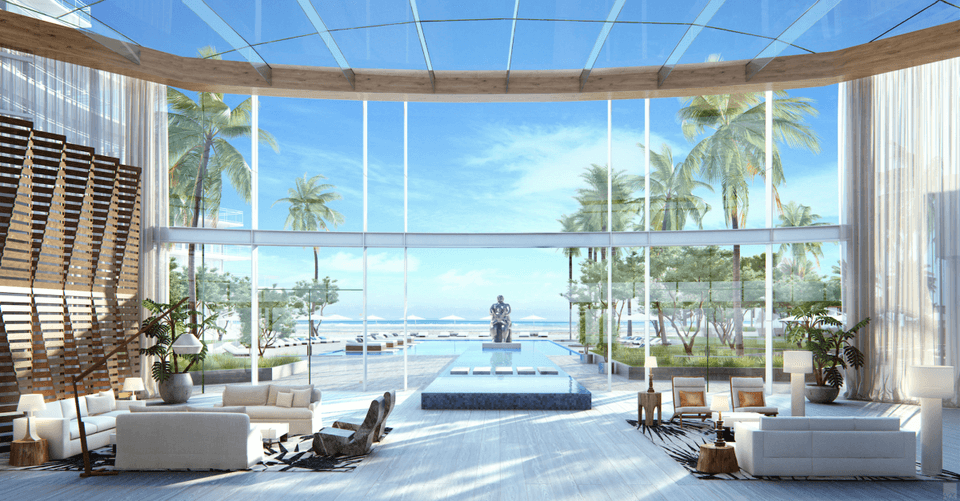
This beachfront property invites Enzo Enea-designed landscapes inside via its massive glass-encased atrium lobby huge planters, giant sheer curtains, and a glass ceiling offering unobstructed views of palm trees, blue skies, ocean, beach, pool and a Fernando Botero sculpture called “La Maternidad.”
1 Great Jones Alley (New York)
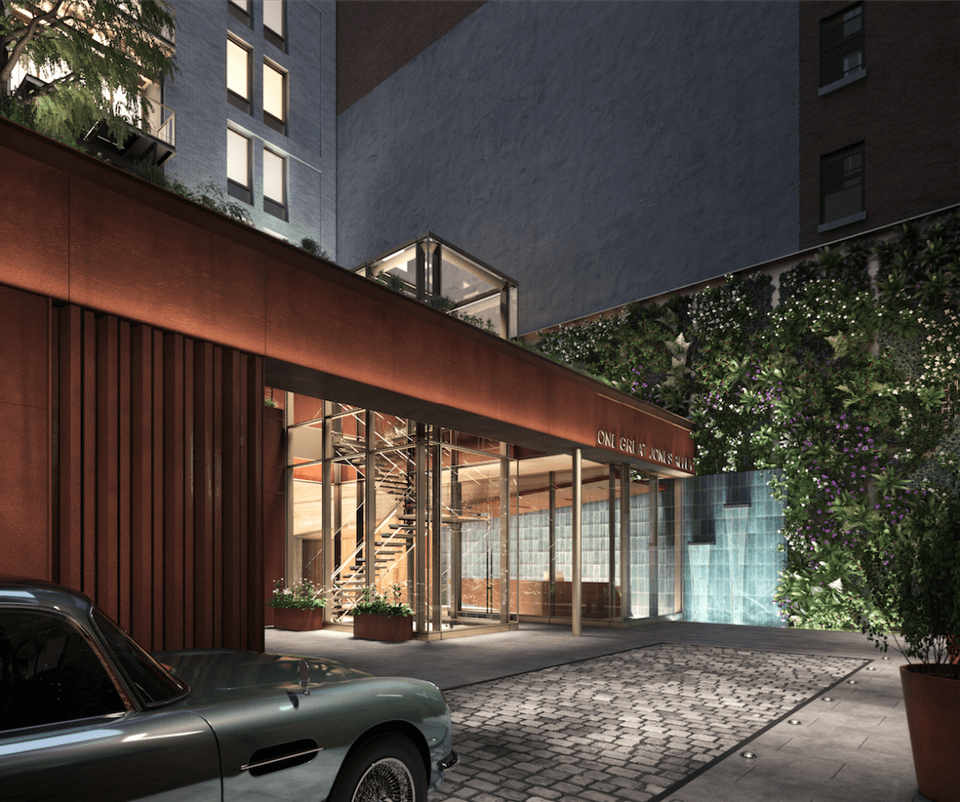
Secluded within an art enclave (where pop art was born), one of downtown’s last alleyways houses this new residential that features a petite garden with biophilic walls, perennials, ferns, vines, shrubs and canopy trees—all of which extend from the second floor to the downstairs porte-cochère alley.
1 Hotel South Beach (Miami)

Kobi Karp Architects designed this eco-conscious hotel with an abundance of natural materials, from graceful twists of driftwood furnishings to this striking entrance with biophilic elements above the lobby threshold and on the imaginative outdoor logo.
19 Park Place (New York)

This double-height attended lobby atrium showcases a living green wall, a 19-foot water feature, and a custom sculpture by Amanda Weil—creating a grand, sophisticated sense of arrival.
49 Chambers (New York)
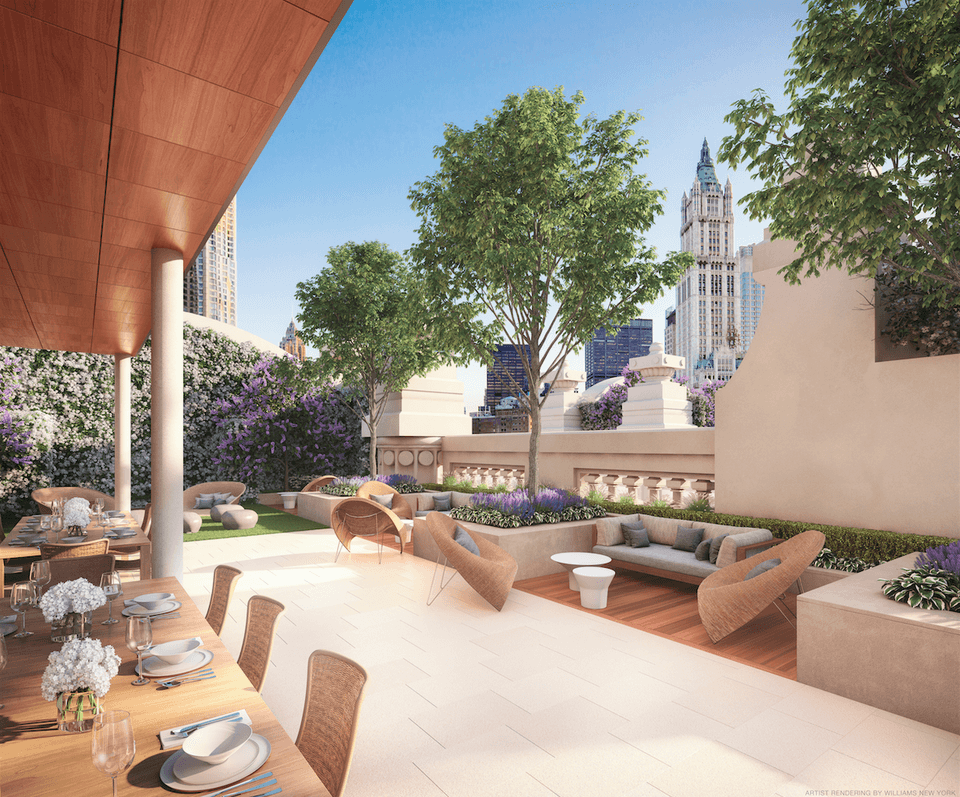
Tribeca’s beautiful Beaux Arts Loft landmark with contemporary condos by Gabellini Sheppard also features an expansive glass-walled rooftop framed by carved limestone balustrades and MPFP Landscape Architects’ garden oasis highlighted by a wall of vibrant foliage, a lawn, outdoor kitchen, and a panorama of City Hall Park, The Woolworth Building and One World Trade Center.
535 Carlton (Brooklyn)

COOKFOX Architects’ sustainable 18-story residential includes a lobby with a biophilic green wall element against a striking backdrop beneath a wood ceiling and eclectic chandelier so residents can contemplate or refocus upon arrival and departure.
Austin Nichols House (Brooklyn)

Framed by a wood-beamed ceiling, Plant By Wall Design’s massive floor-to-ceiling green wall dominates the reception area with 3,500 plants over 500 square feet.
252 East 57th Street (New York)

In this SOM-designed residential, Skidmore, Owings & Merrill, Daniel Romualdez, and Mathews Nielsen Landscape Architects all worked their magic on this unique lobby, which represents a peaceful homecoming as residents traverse a walkway between water pools en route to a floor-to-ceiling green wall, a brass table planter and the front desk.
525 W. 52nd, New York
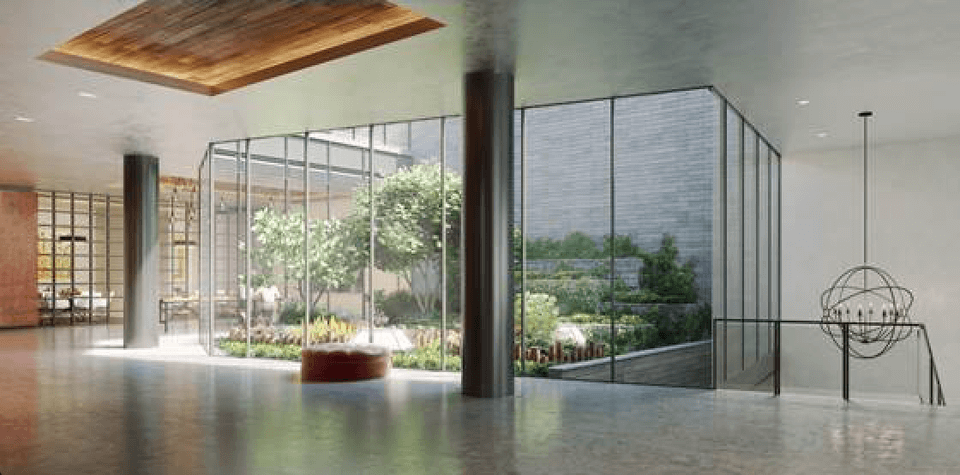
In Hell’s Kitchen, residents are greeted by a sun-drenched two-level atrium that relaxes from the second floor lobby to the cellar. This tranquil setting by Future Green Studio boasts a green wall and lush viewing garden (with pre-historic plants) inspired by tsubo niwa Japanese gardens.
The Original Article Published On The New York Times
By Tim McKeough
Beginning next month, residents coming home to the new 392-unit rental building at 525 West 52nd Street will be welcomed by a lobby with an interior garden as its centerpiece. Enclosed in glass on three sides, like some giant terrarium, but open to the sky, the inaccessible landscape will sprout with ferns, horsetail and magnolia trees.
“It’s reframing landscape almost as art,” said David Seiter, the founding principal and design director of Future Green Studio, the landscape design firm creating the garden. “Our cities are getting denser, and we’re trying to find unique ways of weaving the wild back into our built environment.”
Indeed, Future Green Studio has developed a specialty in coaxing plants to grow in unlikely places — in pockets of a sculptural courtyard wall at 520 West 28th Street, for example, and across an indoor green wall at 60 White Street.

“We’re often dealing with slivers of landscape,” Mr. Seiter said, noting that bringing greenery indoors as an artlike focal point in building lobbies is emerging as “a huge trend.”
“It becomes a big visual feature that lends a softness that makes the space much more human,” said Adrienne Albert, the chief executive of the Marketing Directors, which is leading marketing and leasing at 525 West 52nd Street. “It started with rooftop decks that went from a few plants in pots to really beautiful installations,” she said, “including green walls and sculptural areas” — elements that are now moving indoors.
At Austin Nichols House, at 184 Kent Avenue in Williamsburg, Brooklyn, the lobby has an enormous green wall by Plant Wall Design measuring roughly 500 square feet and holding some 3,500 plants. “It feels warm and inviting, it produces oxygen and it sets up the experience of the courtyards” inside the building, said Morris Adjmi, the architect overseeing the condo conversion project. “It’s also a very graphic planting, with a range of greens in a wavelike pattern.”
Although they may look complex, green walls are relatively easy to maintain, said Ismael Leyva, an architect who is putting a 23-foot-tall vertical garden by Parker and EcoWalls in a lobby he designed for 507 West Chelsea. “They’re basically self-sufficient, because they have an irrigation system,” he said, and work with natural light or grow lights. “You can just replace some of the trays if you need to.”

Sometimes these plantings are combined with water features to create the feeling of an oasis. At 252 East 57th Street, residents traverse a walkway between babbling pools of water to enter the lobby, designed by Skidmore, Owings & Merrill, Daniel Romualdez and Mathews Nielsen Landscape Architects, before encountering a floor-to-ceiling green wall and a long brass table brimming with plants.
“We tried to have tactile, auditory and visual components, all tied to nature, to provide therapy for the senses,” said Julia Hodgson, a project executive at World Wide Group, which is developing the building with Rose Associates. “It’s probably becoming common for a reason: People respond well to having nature inserted into their home environments.”
At Citizen360 at 360 East 89th Street, there are plans for a green wall by Town & Gardens behind a burnished-steel and oak reception desk, with an integrated scupper that splashes water into a pool. On the floor, stepped slabs of limestone will create the feeling of a rock garden.
“We’re working with biophilia, which is the positive effect of nature on all living things,” said Clodagh, the interior designer, noting that she was inspired by the pocket-size Paley Park on East 53rd Street. “You’re in the concrete jungle, and all of a sudden you see water and greenery and get this splash of wellness.”
By using a similar idea at Citizen360, she said, “we want our lobby to give you a welcome hug when you walk in.”


